
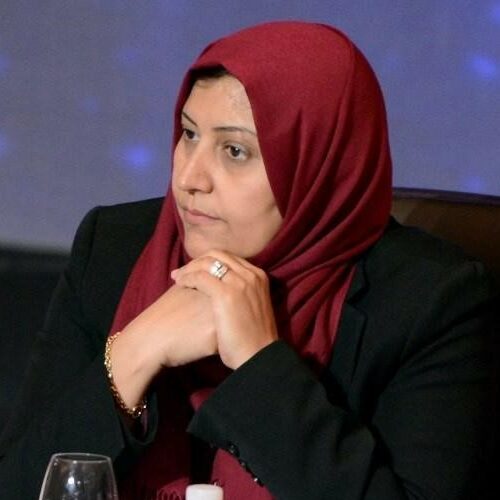
Dr. Bilqis Ahmed Mansoor AbuOsba
Founder, AWAM • Associate Professor of Political Science • Deputy Chair, Yemen Consultation & Reconciliation Commission
Yemeni political scientist, associate professor, and founder of the AWAM Foundation for Development and Culture. Her public work includes academic research, anti-corruption governance, and advocacy for women's participation in Yemen's peace process.
Dr. Bilqis AbuOsba's academic career began at Sana'a University, where she earned a Bachelor of Arts in Political Science with honours in 1989. She continued her studies at Cairo University, completing a Master of Arts in 1997 and a PhD in Political Science — with a specialisation in political systems — in 2003.
She teaches political science and is identified in a current Queen Arwa University journal profile as an associate professor.
Dr. AbuOsba founded AWAM, which was legally established in 2008 and registered with Yemen's Ministry of Social Affairs and Labor under licence 68/148.
Awam's documented partnerships include work with UN Women, Oxfam, the International Organization for Migration, Friedrich Ebert, MEPI, and other development partners.
Dr. AbuOsba served as Vice-Chair of Yemen's Supreme National Authority for Combating Corruption from 2007 to 2013 and participated in work connected to implementation review of the United Nations Convention Against Corruption.
Across Yemen's peace process, she participated in the 2016 Kuwait talks, served in the UN Special Envoy's Women's Technical Advisory Group during the 2018 Stockholm consultations, and attended the 2019 Riyadh Agreement signing. In July 2026, she was named among the deputy chairs of Yemen's Consultation and Reconciliation Commission.
- Founding member: Yemeni Women's Pact for Security and Peace
- Founding member: Arab Women for Peace Initiative
- Member: Global Mediating Women Initiative
- Member: Regional Alliance for the Defense of Women Human Rights Defenders
- The Ruling Political Elite in Yemen during 1978–1990. Madbuli Library, Cairo, 1999